
I. Individualized Therapy and Pharmacogenomics (PGx) Projects
Our research focuses on personalized medicine, an approach that tailors care to each patient based on the specific characteristics of their tumor and their body. This precision medicine aims to enhance the effectiveness of customized treatments while reducing side effects.
Pharmacogenomics (PGx) at the heart of our projects, helps to strengthen the safety and efficacy of treatments and improve survival rates for young patients.
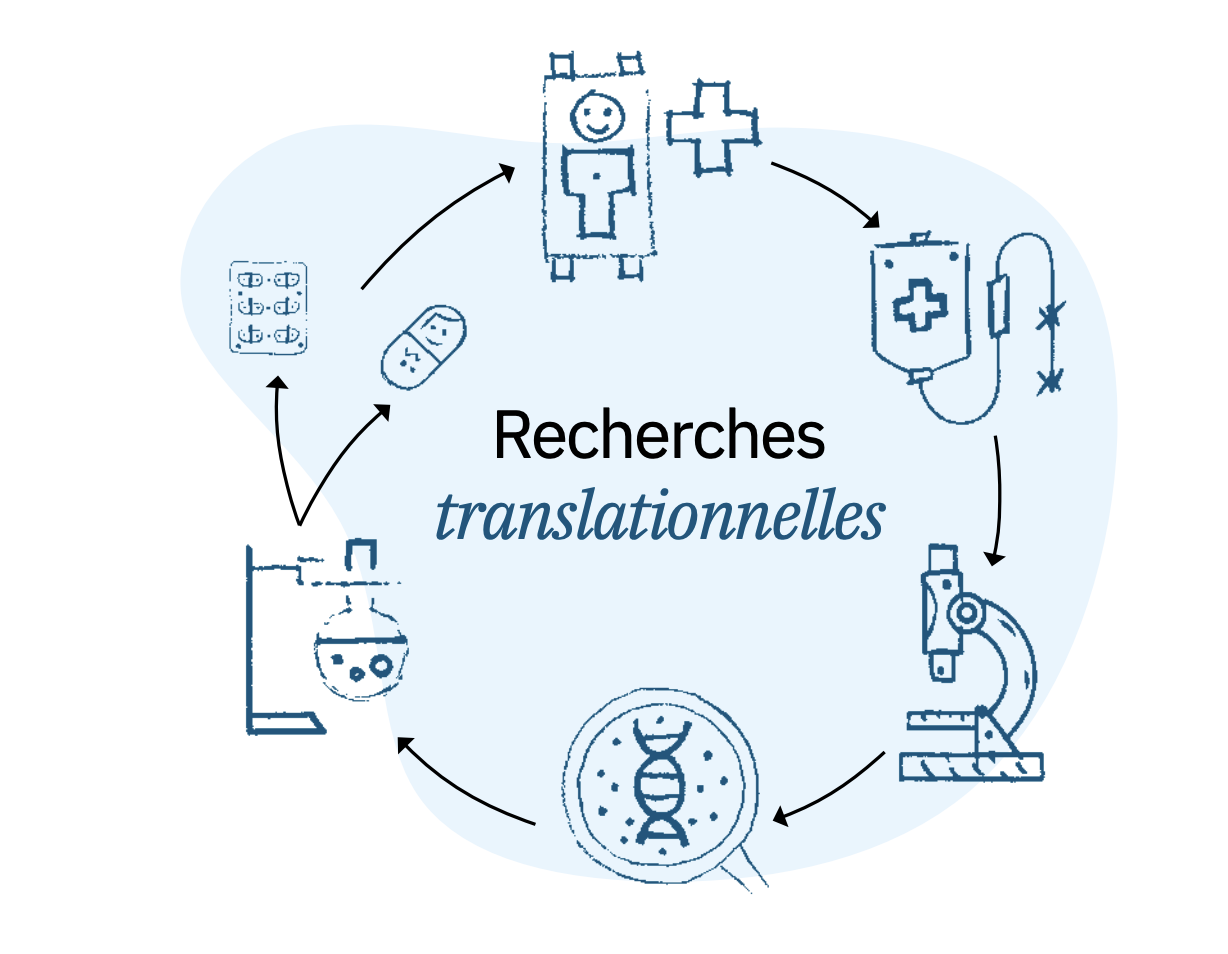
The "PGx umbrella" covers and connects all our pharmacogenetic studies. By definition, it is very broad and highly translational. Translational research is a bidirectional scientific process that accelerates the transfer of discoveries from basic research into concrete clinical applications, "directly to the patient's bedside," and vice versa. It aims to improve diagnostics, treatments, and prevention by bridging the gap between the laboratory and the patient.
1. FORUM 1.0 This study aims to optimize treatments for children with acute lymphoblastic leukemia (ALL) requiring a transplant by individualizing doses to reduce toxicity through biomarkers and genetic factors. Therapeutic management for children cannot be modeled on that of adults, hence the need to specifically study pre-transplant conditioning in pediatric acute lymphoblastic leukemia. The international Forum 1.0 study, the largest to date, demonstrated the superiority of total body irradiation in children over 4 years old. However, the data from this ongoing study still contain a wealth of valuable information. They highlight the value of a personalized approach for chemotherapies such as busulfan: individual dose adjustment, based on pharmacological monitoring and predictive models, improves efficacy while reducing toxicity. By optimizing the benefit/risk balance, these adjustments could rival irradiation, the standard treatment which is associated with long-term effects. Our work thus aims to guide clinicians toward the right treatment at the right dose for each child. For example, by precisely adjusting the busulfan dose, we have managed to reduce relapse in ALL patients after hematopoietic cell therapy (stem cell transplant) by nearly 20%—results that have just been published in the prestigious scientific journal, Blood Advance. This study compares different strategies for preparing the patient for an allograft (conditioning) to optimize allogeneic hematopoietic stem cell transplantation (HSCT). For some children with high-risk or relapsed ALL, a stem cell transplant is necessary after remission. A key step before the transplant is conditioning—an intensive treatment aimed at eliminating leukemic cells and preparing the body to receive the graft. Given the various treatment options available today, our work continues in the laboratory to guide practitioners in the therapeutic management of children with leukemia by helping them choose customized treatment.
2. FORUM 2.0 This study is the continuation and scientific evolution of the first FORUM 1.0 trial. It aims to further optimize the management of children, adolescents, and young adults with acute lymphoblastic leukemia (ALL) who receive a stem cell transplant. FORUM 2 reflects a modern, stratified, and personalized approach that allows for customized treatments to improve transplant outcomes and adapt conditioning to the specific characteristics of patients, with the goal of improving short- and long-term results and reducing the need for radiotherapy. This study examines genetic, pharmacokinetic, pharmacodynamic, and biomarker factors to optimize individualized therapeutic approaches. Three associated projects aim to:
- identify the genetic factors influencing the response to the transplant,
- optimize busulfan and fludarabine doses in children without irradiation,
- model etoposide exposure to define optimal doses.
Other complementary studies are currently being developed. These include, among others, pharmacogenomics, pharmacokinetics, and biomarker research for ruxolitinib, or the establishment of an ex vivo drug testing procedure to predict the efficacy of steroids and ruxolitinib in children with graft-versus-host disease, as well as monitoring the long-term toxicity of transplant treatments.
3. DETeCT This innovative approach aims to identify new genetic mutations linked to the side effects of conditioning treatments in the laboratory, in order to better personalize therapies for children. By replicating these treatments in the laboratory on cancer and normal cells, researchers analyze their response to better personalize doses and reduce toxicity. Faced with the limitations of traditional genetic studies, which are often restricted by the small number of patients, the DETeCT project proposes an unbiased strategy based on cellular models. By combining functional genetics and gene expression analysis, it allows for the identification of new mechanisms involved in the response to treatments, with the goal of optimizing the choice and dose of medication for each patient. This innovative project has just been supported by a highly competitive fund: the Swiss National Science Foundation.
4. MyeChild 01 This large international study, bringing together Great Britain, France, Australia/New Zealand, Ireland, and Switzerland, focuses on acute myeloid leukemia (AML) in children and aims to improve the efficacy of anti-leukemic treatments and reduce their toxicity by exploring the links between genetics and drug response. It evaluates several chemotherapy strategies and includes an internal drug dose-finding study. As part of this study, our research platform is conducting a pharmacogenetic (PGx) sub-study aimed at investigating the genetic determinants of treatment response. We are attempting to identify genetic polymorphisms associated with both ineffectiveness and susceptibility to each of the treatments in the study, starting with the components used for preparation for hematopoietic stem cell transplants. To do this, we have access to clinical and pharmacokinetic data as well as the genetic material of all MyeChild study patients who have consented to PGx genetic analysis. We are currently organizing the shipment of genetic samples and the transfer of clinical data in order to proceed with sequencing and subsequent analysis.
5. SCRIPT AML This new study compares two conditioning protocols for transplants in children with acute myeloid leukemia (AML) in order to improve treatment efficacy while reducing the risks of relapse and toxicity. The treatments administered during the pre-transplant preparation phase are highly toxic and present a significant risk of side effects. The toxicities resulting from conditioning treatments are closely linked to the amounts of medication administered. At the same time, there is a significant risk of relapse (20-30%), which is intrinsically linked to the AML diagnosis, and treatment ineffectiveness resulting from under-dosing must be carefully avoided. Furthermore, there is significant variability in treatment response from one child to another, further complicating the difficulty of correctly assessing the doses of medication to prescribe to each patient. SCRIPT AML incorporates pharmacokinetic and pharmacogenetic sub-studies aimed at better understanding the variability in treatment response and optimizing doses in an individualized manner. The results will complement those of the MyeChild 01 study.
6. BuGenes 01: This prospective, multicenter, randomized clinical trial aims to improve the precision of busulfan dosing—a key medication prior to stem cell transplants—by accounting for genetic variants to reduce toxicity and increase treatment efficacy. The goal is to enroll over 260 patients across more than ten countries and 21 sites. This study is one of the first in Europe to systematically integrate genetic markers into chemotherapy dosing for children. It compares the standard approach based on clinical parameters with an innovative approach incorporating pharmacogenetic data, specifically variations in the GSTA1 gene. The objective is to enhance dosing accuracy to reduce toxicity while boosting treatment effectiveness, paving the way for truly personalized chemotherapy. If the pharmacogenetic approach proves more precise and safe, it could influence international guidelines for pre-transplant busulfan dosing, leading to more personalized medicine with fewer toxicities and complications for young patients.
7. FLEX01 Fludarabine Fludarabine is a chemotherapy agent that inhibits DNA synthesis, thereby preventing the division and proliferation of cancer cells, particularly those of the immune system. Once activated in the body, it blocks enzymes essential for DNA replication, leading to cell cycle arrest and tumor cell death. Currently based on parameters like weight or height, dosing does not always reflect actual exposure, leading to risks of toxicity or inefficacy. This project seeks to define optimal exposure by integrating genetic factors and drug interactions to improve efficacy while reducing side effects. It also includes the development of algorithms to personalize doses for each patient. In 2025, the study obtained ethical approval, and a method for measuring fludarabine was developed. A model for predicting concentrations in children is now available.
8. PK Modelling - DDI This research project uses pharmacokinetic models to predict and prevent drug-drug interactions in children with cancer, focusing on specific enzymes and medications such as busulfan and fludarabine.
9. GECCOS (Genetic Effects in Childhood Cancer Outcomes and Survivorship) This research program identifies genetic risks for complications in pediatric cancer survivors in Switzerland, focusing initially on pulmonary, auditory, and cardiac toxicities, as well as secondary tumors.
9a. Ototoxicity (GECCOS) This project studies the genetic factors associated with ototoxicity, which refers to irreversible hearing damage caused primarily by platinum-based chemotherapies (cisplatin and carboplatin) that affect the inner ear in children. The inner ear contains the cochlea, a structure involved in both hearing and balance. Consequently, three main symptoms are associated with ototoxicity: hearing loss, tinnitus, and dizziness. While highly effective, cancer treatments frequently cause irreversible hearing impairment, with significant variability between patients. Hearing loss is particularly problematic in young children, as they are at a crucial stage for speech learning and the development of communication skills. The goal of this study is to identify the genetic variations and drug interactions (notably with vincristine) involved in this toxicity by combining genetic analyses, cohort studies, and experimental models. This work aims to better understand the mechanisms of ototoxicity in order to adapt treatments and reduce long-term sequelae. A systematic review and cohort analyses have been completed, and a genome-wide study is underway. The project is supported by the Swiss National Science Foundation (SNSF). It also supports a PhD student within the research platform. The results of this research project could help improve the personalization of chemotherapy treatments for children. In the future, identifying genetic risk factors and gaining a better understanding of drug interactions could allow clinicians to adapt therapeutic strategies—for example, by adjusting cisplatin doses—to effectively treat cancer while minimizing the risk of long-term hearing loss.
10. CsA (Cyclosporine) Cyclosporine is an agent used to prevent transplant rejection by inhibiting T-cell activation, thereby reducing the body's immune response. The CsA project studies the use of cyclosporine in pediatric transplant patients to prevent graft-versus-host disease while limiting side effects. The goal is to optimize dosing in a complex context marked by numerous drug interactions (notably with antifungals like fluconazole) and the transition between intravenous and oral administration, which makes treatment exposure highly variable. Using pharmacokinetic models, the study allows for the prediction of cyclosporine concentrations and the adjustment of doses based on clinical situations. This work leads to recommendations aimed at making its use in children safer and more personalized.
11. MTX (Methotrexate) PGx FORUM: This project aims to better prevent graft-versus-host disease (GvHD) after transplantation by analyzing the genetic factors influencing the efficacy of methotrexate (MTX), a key preventive treatment. Leukemia affects the function of blood stem cells. Hematopoietic stem cell transplantation replaces the patient's diseased cells with healthy cells from a donor, restoring the blood cell production process. GvHD occurs when the donor's healthy stem cells attack the recipient's cells. This happens if the donor cells perceive the recipient as a foreign body. Despite the systematic administration of preventive treatments, the incidence of GvHD remains high. By leveraging patients from the FORUM study, this research seeks to identify genetic variants associated with an insufficient response to treatment, in order to better understand the mechanisms involved and to adapt prophylaxis in a personalized manner.
12. MPGx IndALL: The IndALL project aims to improve the management of acute lymphoblastic leukemia (ALL) in children in India, where survival rates (which hover around only 50%) remain lower than those observed in Europe. It seeks to identify genetic markers associated with treatment response and toxicity in order to better adapt therapies and optimize patient monitoring. We will study both the genetic characteristics of children as inherited from their parents, known as germline, as well as the genetic characteristics of their cancer cells, known as somatic. We hope to provide doctors with tools to identify the patients most at risk who require closer monitoring, which is particularly useful in India where limited resources require efficient allocation. The study thus aims to improve therapeutic strategies in resource-limited settings. We also hope to achieve survival rates for children with ALL in India comparable to those reported in Europe. The study is ongoing, with about half of the patients recruited. A first sequencing phase (>100 patients) has been completed, and data analysis is underway to identify markers for validation. Professor Uppugunduri and Professor Ansari have obtained a grant from the Swiss National Science Foundation (SNSF) for the IndALL project. There are plans to open a CANSEARCH satellite research platform in Pondicherry, India, in 2026.
13. CBF AML: This project investigates a rare and aggressive form of pediatric acute myeloid leukemia associated with the CBFA2T3::GLIS2 gene fusion, which is characterized by a very poor prognosis. It aims to better understand the molecular mechanisms of this disease in order to identify new therapeutic targets. Preliminary work conducted at the Dana-Farber Cancer Institute (Boston) by our researcher, Dr. Fanny Gonzalez, has shown that this leukemia is highly dependent on the JAK2 pathway, opening up a new therapeutic avenue: the use of inhibitors already available in clinical practice. However, resistance mechanisms involving the MAPK pathway have been identified, suggesting the potential of therapeutic combinations, the efficacy of which has been demonstrated in preclinical models. This study aims to better understand the specific roles of the genes involved in the differentiation process. This in-depth understanding of the underlying mechanisms will allow for better targeting of these genes for precise therapeutic interventions, paving the way for more effective and better-tolerated therapies for patients.


