
CANSEARCH research projects in 2025
An overview of the various research areas led by the CANSEARCH Research Platform team in pediatric oncology and hematology at the University of Geneva, and their practical application in cancer treatment.
Pediatric cancers differ from adult cancers because they are linked to cellular development rather than aging. Their rapidly growing cells are more susceptible to mutations, and treatments—particularly chemotherapy—cause more severe side effects in children. Despite this, these cancers remain under-researched. To address this, Prof. Marc Ansari, in collaboration with the HUG and the University of Geneva, established the CANSEARCH Foundation and its Pediatric Oncology and Hematology Research Platform at the University of Geneva in 2011. The primary mission of the CANSEARCH Foundation is to fund medical research into childhood cancers and blood diseases, with the goal of better understanding the disease, reducing the toxicity of treatments and their side effects, and improving the efficacy of current therapies.
Individualized therapy: A comprehensive pharmacogenomics project
Our studies focus on personalized healthcare. This precision or individualized medicine is tailored and optimized for each patient based on the unique characteristics of their tumor and their body. This approach aims to improve treatment efficacy while limiting side effects.
Pharmacogenomics, at the heart of this approach, studies how genetic variations influence the response to medication. It allows us to predict whether a patient will respond well, poorly, or not at all to a treatment. In pediatric oncology, where chemotherapy can be highly toxic and its efficacy variable, this science is essential. Through individualized therapy, it becomes possible to adjust medication doses for each child, increasing the chances of recovery, reducing the risk of relapse, and limiting adverse effects, which can sometimes be severe or long-lasting.
In oncology, it has been shown that 20% of patients do not respond to standard treatment. The therapeutic agents used in cancer chemotherapy are ideal candidates for pharmacogenomic study because they are often administered at doses that produce severe toxicity with highly variable individual responses. Their use must therefore be optimized to achieve the best effect. Short- and long-term toxicity affects more than 40% of cancer patients and can be life-threatening or cause permanent disability. The pharmacopeia in this field therefore has the potential to improve drug safety and efficacy, thereby increasing the survival rate of children.
Initially, we focused on a drug called busulfan (Bu), which is frequently used during hematopoietic stem cell transplants in children. It is a complex drug to manage because finding the right dose for each patient is difficult. Thanks to progress made in the use of busulfan, we have expanded our research to other important drugs used before or after transplantation, such as those that prevent or treat certain reactions of the body against the graft (such as graft-versus-host disease). While properly dosing busulfan remains a challenge, we are now working to understand the entire treatment process to better adapt it to each child.
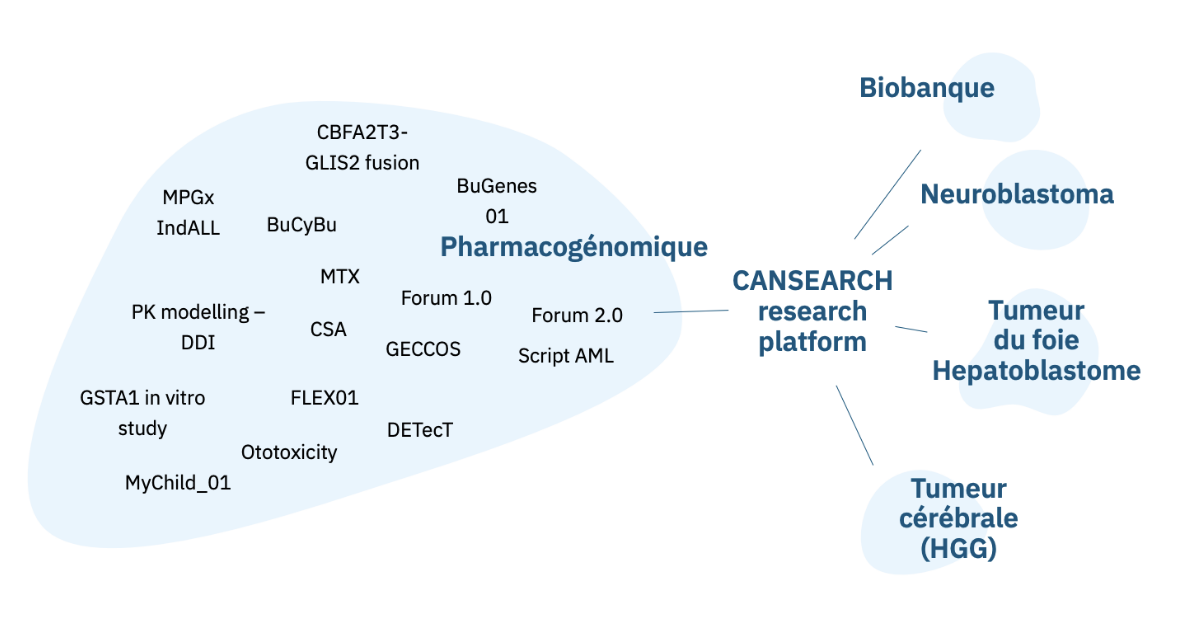
Our research projects explore 10 major themes. The primary one, focused on personalized medicine (pharmacogenomics and therapeutic monitoring of chemotherapy), covers and links all our various studies (pharmacogenetics - PGx). It is subdivided into 13 sub-projects.
- Pharmacogenomics (PGX) and individualized therapy projects
- Hematopoietic Stem Cell Transplantation (HSCT)
- BaHOP Biobank
- Neuroblastoma project
- Brain tumor project
- Liver tumor project - RELIVE - SWISSLIVERRE
- Drug profiling
- Leukemia project
- Genetic risks of post-treatment complications
- Benign hematology (e.g., sickle cell disease)